Is AI-built software safe to run your business on?
Handing an AI the system that tracks your customers, your money, and your operations is a reasonable thing to hesitate over. But the answer doesn't hinge on whether an AI was involved. It hinges on what the software stands on, and what happens the day something goes wrong.
The worry is legitimate. Software that holds your customers, your invoices, and your operations deserves hard questions before you depend on it, and "is this safe?" is exactly the right one.
It's just aimed at the wrong word. Whether an AI was involved tells you almost nothing about whether the software is safe. What decides it is how the software is built, what it stands on, and what you can do when something needs to change, or breaks.
The real risk is improvisation, not AI
There is a risky way to point AI at a business problem: have it write bespoke code from scratch. That's "vibe coding", a pile of one-off logic reinvented from nothing every time, with no standard structure underneath. It demos beautifully. But for the system your business runs on (where losing data or showing the wrong person the wrong record isn't an option), a fresh improvisation is exactly what you don't want.
So the thing to be wary of isn't "an AI built it." It's "an AI improvised it." That distinction is the reason Snill exists, and we built the whole product around it.
The model is only part of the system
There's a lot of talk right now about AI harnesses, meaning the tools, constraints, permissions and rules wrapped around a model. The idea behind it is simple: the model isn't the whole system. How an AI behaves depends as much on what it's given to work with as on how capable the model is.
The same applies to AI-built software. A better model doesn't automatically make a safer software builder. Give even a strong model an empty directory and ask it to invent an application, and it has to decide everything itself, from how the data is stored to who's allowed to see it. What matters is what the AI is allowed to create and change.
Snill gives the AI a tight harness. It doesn't start from a blank page. It works with a defined model of collections, relationships, permissions, rules and workflows, and every change it makes has to fit that model. (It can't apply a structural change on its own either. It proposes the change, and a person approves it.)
Snill generates a standardized system, not custom code
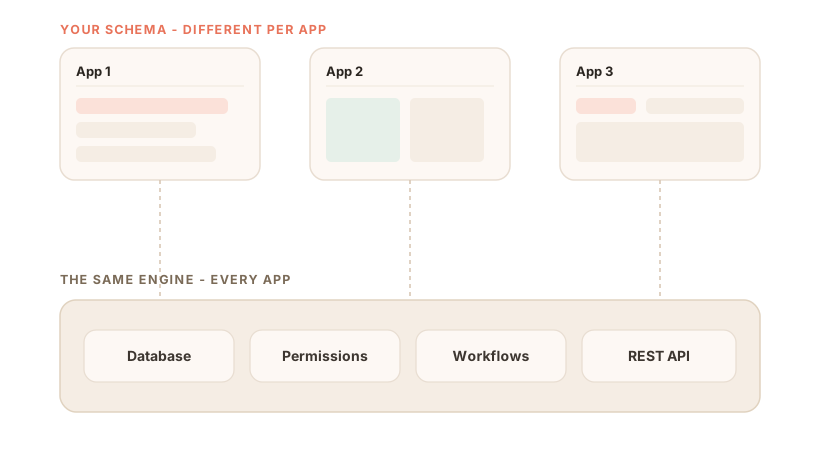
Snill doesn't write your business a bespoke program. Every Snill app runs on the same shared engine: the same database, the same permission system, the same workflow and API layer as every other Snill app. What differs from one app to the next is the schema, the collections, fields, relationships, dashboards, and access rules that describe your particular business.
The AI works at the level of that schema. It turns your description into the specification, and it never generates the engine that executes it. The foundations underneath are the same ones every time, never reinvented for you. You're not trusting an AI to hand-write your data layer, permission checks, and undo story from scratch. You're trusting it to fill in a specification that a known-good engine reads. That's a far smaller thing to trust. And if it gets a detail wrong, you fix the detail, not a tangle of hand-written code.
The guardrails that make it safe to depend on
Standardized foundations are the floor. On top of them, five concrete guarantees do the rest of the work.
1Rules and permissions are enforced, not suggested
Access control and workflow steps run on the server, not just in the interface. An unauthorized or out-of-sequence change is rejected even when it comes through the REST API. And access reaches down to a single field, so "everyone can use the app, but only managers see rates" is an enforced boundary, not a convention people are trusted to respect. (See access control, and how rules are described and enforced.)
2Every change is reversible
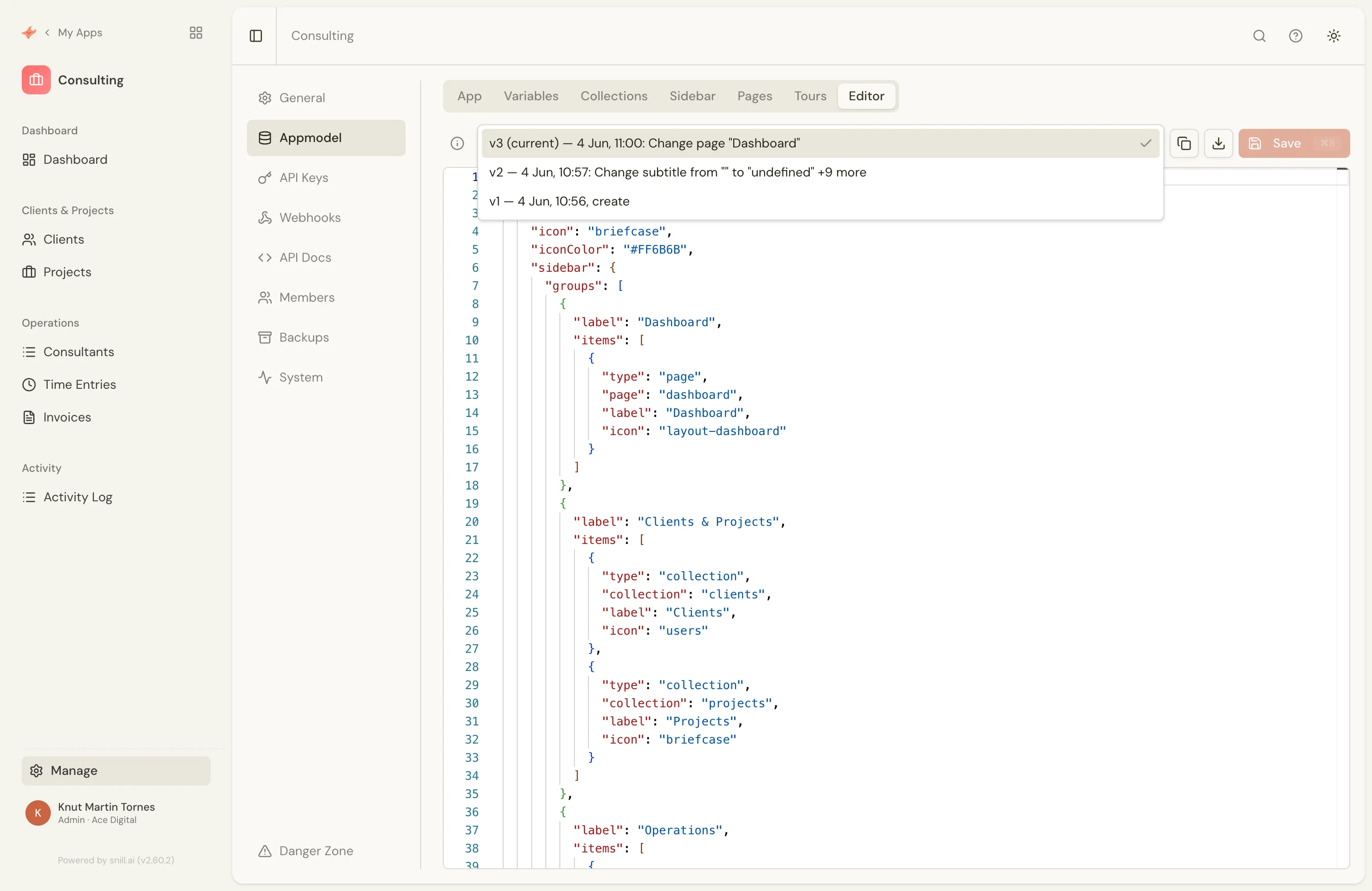
Every change to your app's structure is versioned. If something goes wrong (a rule that does the wrong thing, a field removed too eagerly), you roll back to any earlier version in one click. Nothing is a one-way door. That's what makes it safe to keep changing the system as the business changes.
3There's a complete audit trail
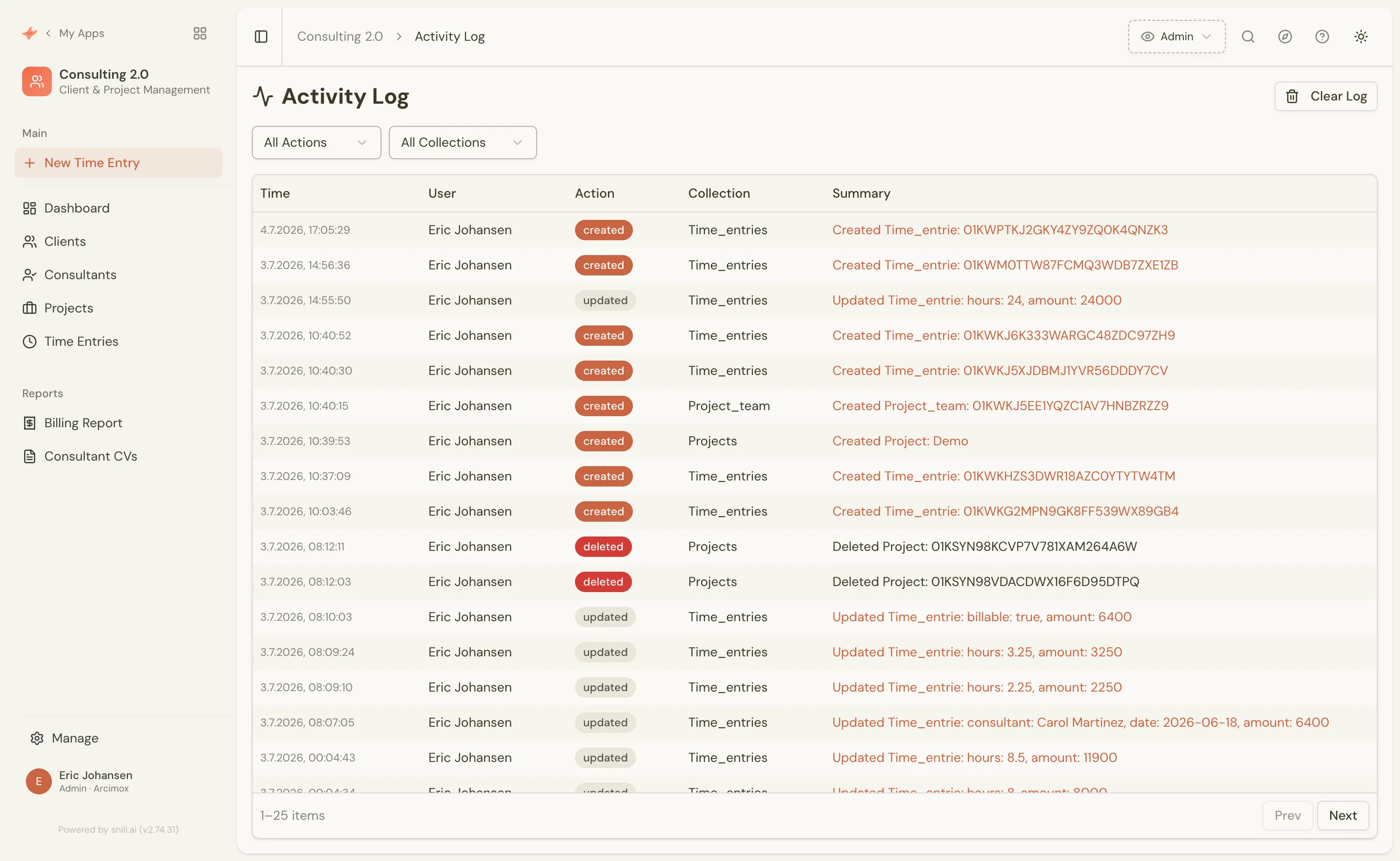
Every data change, and every event your triggers fire, is recorded: who did what, to which record, and when. If something looks off, you don't reconstruct it from memory. You look it up. (See the activity log.)
4Backups you can restore
Versioning covers the shape of the app. Backups cover the data inside it. Your data is backed up automatically every day and kept for 30 days, and you can take your own snapshot before a big change, then restore from any snapshot when you need to. (See backups.)
5Your data is always yours
You can export your records from any collection to CSV or JSON at any time. Software you can trust includes the freedom to walk away with your data, with no lock-in hiding inside the word "safe." (See import & export.)
Speed is only safe with guardrails, and that's the point
The very thing that makes people nervous about AI (it moves fast and can change a lot, quickly) is only dangerous without guardrails. With server-enforced rules, versioned structure, one-click rollback, and a full audit trail, speed stops being the risk and becomes the payoff: you change the system as fast as you can describe the change, and undo anything that doesn't work out.
Fast is only dangerous when there's no way back. That improvised, no-way-back model is exactly what Snill is built to avoid.
Summary
Whether it's safe depends entirely on what "built" means. Improvised from scratch, with no standard structure and no way back, no, and you're right to walk away from that. AI-generated onto shared, standardized foundations, with enforced rules, versioned and reversible changes, a complete audit trail, and backups you control, yes. That isn't a leap of faith. It's ordinary, dependable software that happened to be described instead of coded.
See what it builds → - it's free to start, every change is reversible, and your data is always yours to take.