Build a visitor log by describing it.
Who is on site right now, who they are here to see, and who signed in and never signed out. Here's the prompt and the app it produced.
Ask for it in one go
This is the exact prompt we used. Copy it, change the words that don't match your business, and paste it in.
Keep a visitor log for our sites. Each visit records the visitor name, their company, who they are here to see, the site, the time they signed in and the time they signed out, and whether they were given a badge. Some visitors need a safety briefing before they go on site. Show me who is currently on site and anyone who signed in but never signed out.
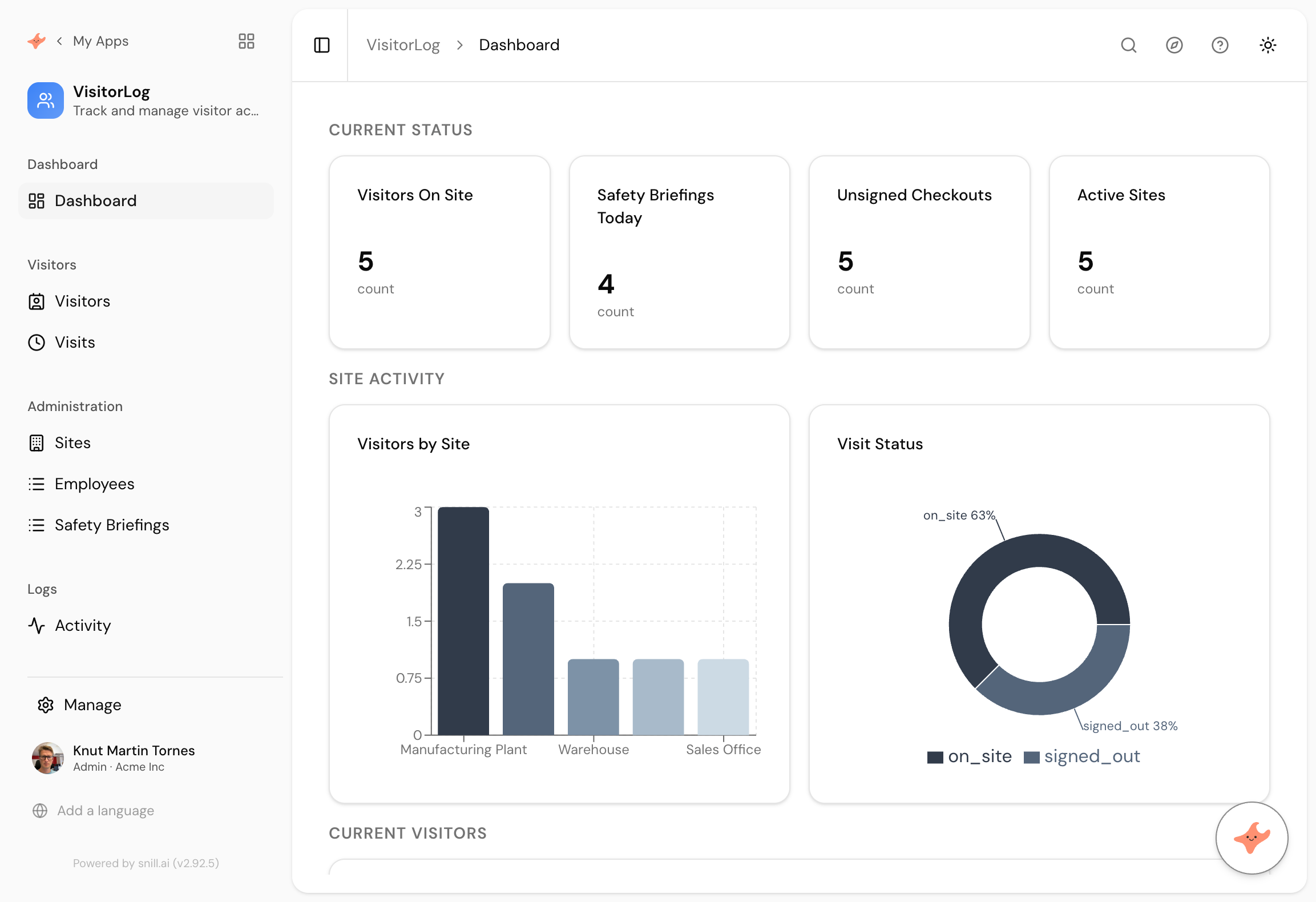
Built in 56 seconds, from that prompt alone.
What came back
Visitors and visits kept apart
A person who comes back four times is one visitor with four visits, not four rows. That is what makes a contractor's history visible instead of scattered.
Safety briefings as records
We mentioned briefings in one clause and it built them a collection, so you can show a briefing was given, when, and to whom. That is the version that survives an audit.
The awkward number, on the front page
Five people signed in and never signed out. Nobody designs that panel into a visitor book, and it is exactly what you need in a fire drill.
Most visitor books are a hardback ledger on a reception desk, and they fail at the one moment they exist for. The building alarm goes and somebody carries the book outside to read names in the rain, hoping everyone who signed in also signed out.
The digital version is not a big app. Visitors, visits, sites, and two questions. Who is here now, and who does the log think is still here.
Visitors are not visits
The prompt described a visit and it built both, with each visit pointing at a visitor.
That separation is what makes the register useful over time. A contractor who comes every fortnight is one person with a history, not thirty unrelated rows. You can see they have been on site twenty times this year and that their safety briefing was in March, which is a question a ledger cannot answer at all.
It also made Safety Briefings a collection from a single clause, so a briefing is a dated record against a person rather than a tick.
The number nobody designs in
Five visitors signed in and never signed out.
No paper book has that view, and it is the most valuable thing on the page. In an evacuation it is your roll call. On a normal Tuesday it tells you the sign-out step is being skipped, which means the on-site number you were relying on is fiction.
Everything the prompt asked for came out populated on this one, with no corrections needed.
Summary
A visitor log is two lists and two questions, and the second question is the one that matters when it counts. This took 56 seconds from a paragraph, separating visitors from visits, building safety briefings as records, and putting unsigned checkouts on the front page. If you want one-click sign-out, briefing expiry warnings or vehicle registrations, those are the next three sentences.
Then change it by asking
The assistant stays with the app after it is built. It proposes each change and a person approves it, so nothing moves on its own.
- Let reception sign someone out with one click from the on-site list.
- Flag visitors whose safety briefing is more than a year old.
- Add the vehicle registration for anyone driving on site.
- Give me visitor numbers by site and by month.
Frequently asked.
Can visitors sign themselves in on a tablet?
Everyone using the app is a user in it, so a self-service kiosk for anonymous visitors is not what this is. Reception signing people in covers most sites. A kiosk means external access, which is worth deciding on separately.
Why does the unsigned-out list matter?
Two reasons, and one of them is serious. It is your roll call in an evacuation, and it is also how you find out that the sign-out step is not really happening, which quietly makes every other number wrong.
Is a paper visitor book not GDPR-safer?
The opposite, usually. A paper book shows every previous visitor's name and company to whoever signs in next. A register with access control shows each person only what they should see, and it can be exported or deleted on request.
Can we record who a visitor is here to see?
Yes, and it is in the prompt. The host is a lookup to an employee rather than typed text, so you can also ask which member of staff hosts the most visitors, which matters for site security more than it sounds.
What does it cost?
Snill is free to start for solo operators, with a Pro plan for teams. Your data and the app's full model are yours to export at any time, as CSV or JSON.
Describe it and see
Free to start. The app is generated in about a minute, and you keep changing it in plain language.
Start free