Build a customer complaints register by describing it.
What went wrong, how bad it is, who is on it, and what has been sitting too long. Here's the prompt and the app it produced.
Ask for it in one go
This is the exact prompt we used. Copy it, change the words that don't match your business, and paste it in.
Log customer complaints. Each complaint records the customer, what happened, a category and a severity, and who is handling it. A complaint moves from new to investigating to resolved or closed. Only a team lead can close one. Show me open complaints by severity and anything unresolved for more than a week.
Built in 74 seconds, from that prompt alone.
What came back
Severity as a real dimension
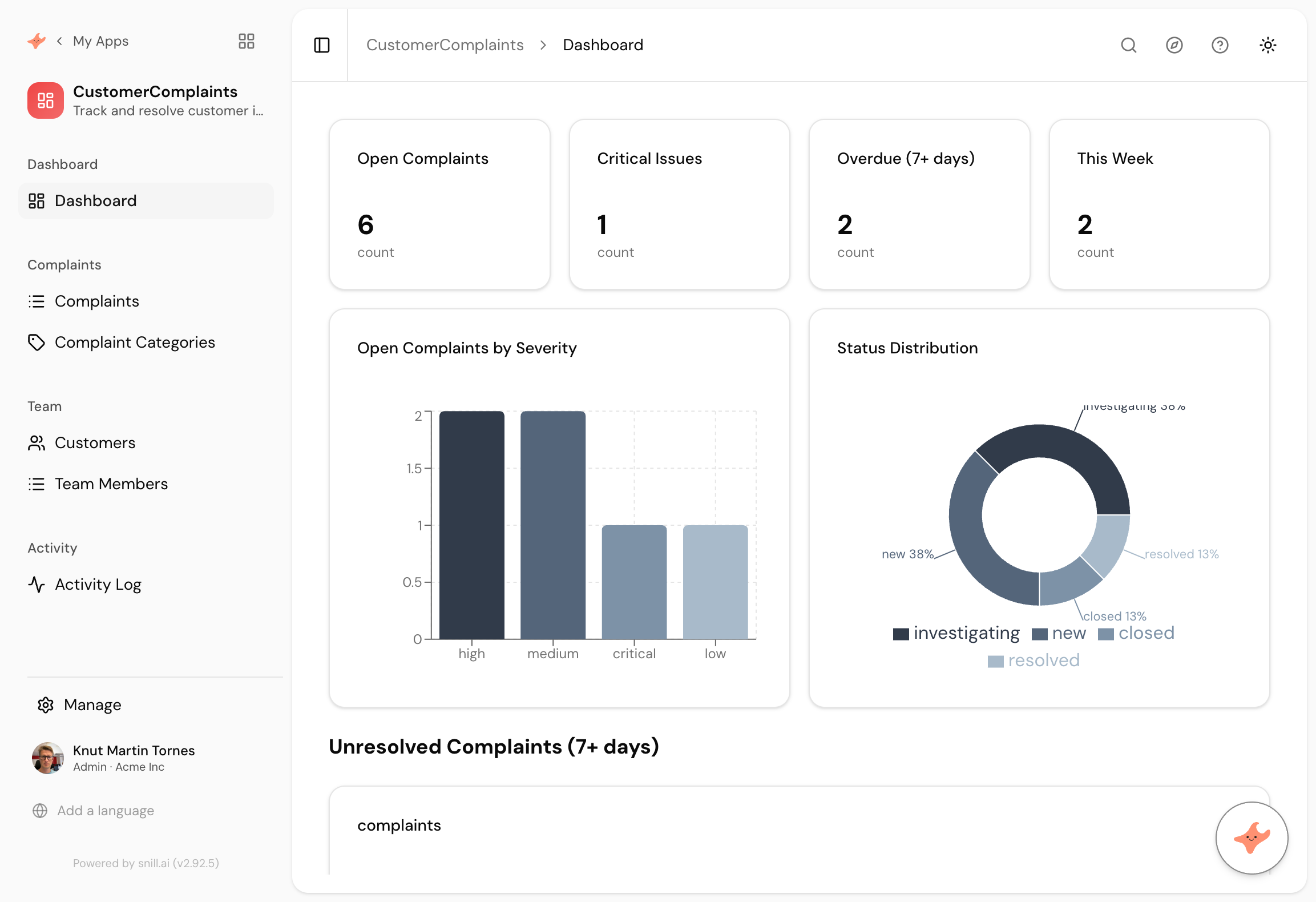
Critical, high, medium and low, charted separately from status. Two people asking different questions, the one who wants to know how bad and the one who wants to know how many, both get an answer.
An ageing panel
Unresolved for more than seven days, counted and listed. This is the number that gets a complaints process taken seriously, and nobody builds it by hand.
Closing as a privilege
Anyone can log and investigate, only a team lead can close. That rule is what stops a complaints register quietly becoming a list of things marked done.
Most complaints registers are a shared inbox and a promise. Something goes wrong, somebody replies, and whether it was ever resolved depends on whether that person remembered. Then a customer asks what happened to the thing they raised in July and there is no answer, which is a worse conversation than the original complaint.
What you need is small and slightly uncomfortable: a record of every complaint, who owns it, and how long it has been sitting. The discomfort is the point.
The number that changes behaviour
The prompt asked for anything unresolved for more than a week, and that panel is the reason to build this. A count of open complaints tells you nothing, because it goes up when business is good. A count of complaints that have been open too long tells you where the process is breaking.
It also split severity from status, which we did not ask for as two separate charts. One answers how bad, the other answers how far along. Managers ask the first question and the team asks the second.
Nothing needed fixing here
This one came out usable first time, like the purchase request app and unlike the three with expiry dates in them. The dashboard counts and ages records rather than comparing a stored date against today, so the sample data could not land in the wrong place.
Worth linking that pattern back to your own prompt before you write it. If the screen you care about is “what expires soon”, plan for one follow-up message. If it is “what is open and how old”, it will come out right.
Summary
A complaints register is a list plus an uncomfortable clock, and the clock is what makes it worth having. This one took 74 seconds from a paragraph, arrived with severity and status charted separately, an ageing panel, and closing restricted to a team lead. Nothing needed correcting. If you want mandatory resolution notes, per-handler views or photo attachments, those are the next three sentences.
Then change it by asking
The assistant stays with the app after it is built. It proposes each change and a person approves it, so nothing moves on its own.
- Add a resolution note that has to be filled in before a complaint can be closed.
- Show each handler only the complaints assigned to them.
- Let people attach a photo or a document to a complaint.
- Give me complaints by category for the last quarter.
Frequently asked.
Is this a helpdesk?
No. A helpdesk handles conversation, email threading and SLAs against replies. This is a register of things that went wrong, who owns each one and how long it has been open. If you need to talk to the customer inside the tool, use a helpdesk.
Why does the ageing panel matter so much?
Because it is the only part of a complaints process that creates pressure. A list of open complaints tells you nothing. A list of complaints open longer than a week tells you where the process is failing, and it is the first thing an auditor asks for.
Can we stop people closing their own complaints?
That is what the role rule does. Closing is restricted, so the person who logged it and the person who fixes it are not the person who decides it is finished. Ask for whatever split matches how your team works.
Does it handle quality deviations too?
The same shape works, and there's a ready-made incident reporting template if you need HSE incidents and corrective actions specifically. Complaints and deviations are the same app with different vocabulary.
What does it cost?
Snill is free to start for solo operators, with a Pro plan for teams. Your data and the app's full model are yours to export at any time, as CSV or JSON.
Describe it and see
Free to start. The app is generated in about a minute, and you keep changing it in plain language.
Start free