Build a grant application tracker by describing it.
Which deadlines are coming, who is writing what, and how much you have actually been awarded. Here's the prompt and the app it produced.
Ask for it in one go
This is the exact prompt we used. Copy it, change the words that don't match your business, and paste it in.
Track the grants we apply for. Each application names the funder, the programme, the amount we are asking for, the person writing it and the submission deadline. It goes from identified to drafting to submitted to awarded or declined. Only a director can mark one as submitted. Show me deadlines coming up in the next 30 days and the total we have been awarded this year.
Built in 58 seconds, from that prompt alone.
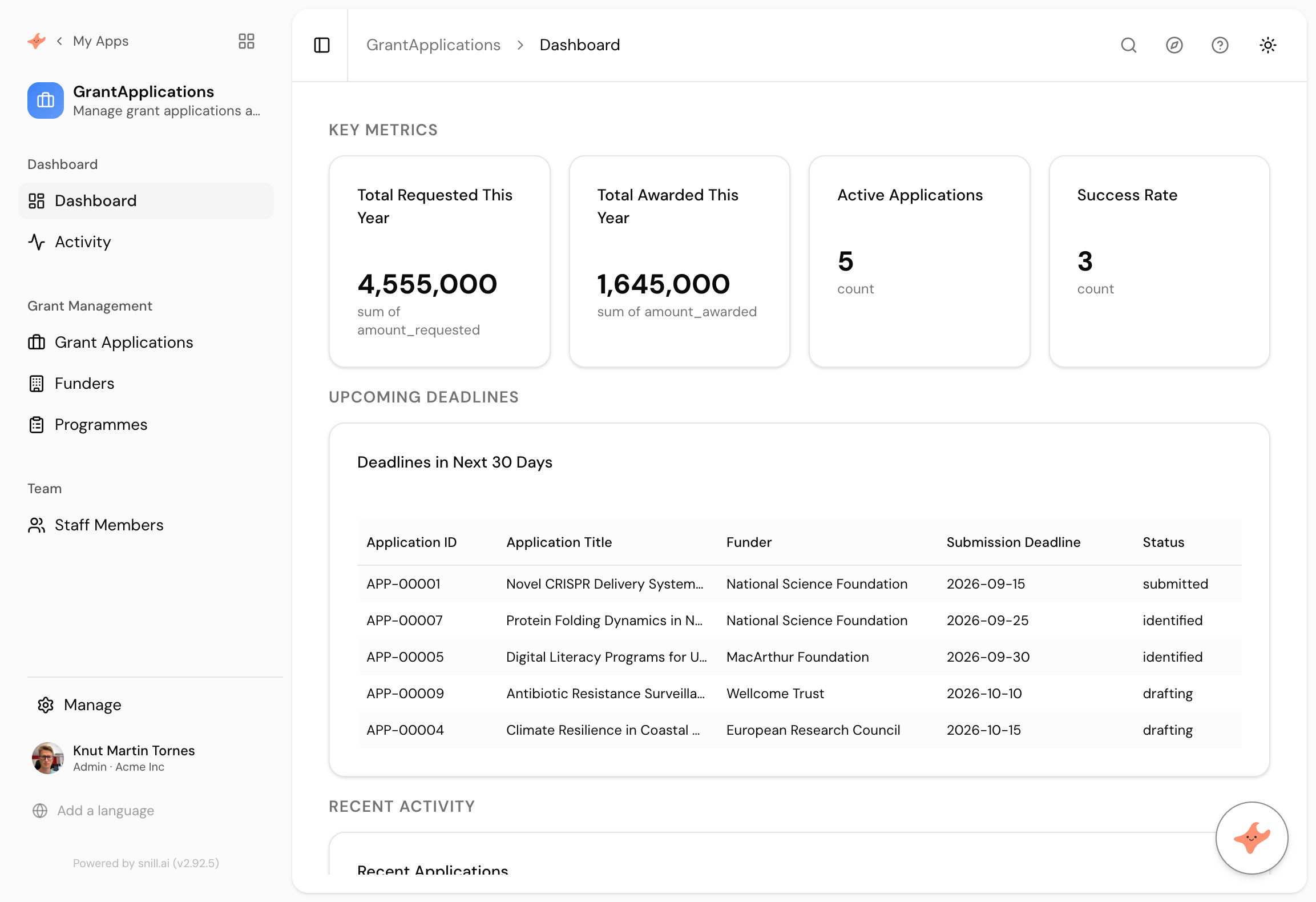
What came back
Funders and programmes kept apart
One funder runs several programmes, and applications point at both. That is what lets you ask how you do with a particular funder across years rather than only per application.
Requested against awarded
Two sums side by side, 4.5 million asked for and 1.6 million awarded. Counting applications tells you how busy you were. This tells you how you did.
A deadline list, not a deadline field
Deadlines in the next 30 days is the first table on the page, because a grant deadline is the one date in this whole app that cannot slip.
Grant funding runs on deadlines that do not move and a memory of what worked last time. Most organisations hold both in one person’s head and a folder of documents named final_v3.
The tracker that helps is not complicated. Applications, the funder behind each one, the money, and the date. What makes it worth having is that it survives the person who currently remembers all of it.
Funders and programmes as separate things
We named both in one sentence and it kept them apart, with applications pointing at each.
That matters more than it looks. A funder runs several programmes over several years, and the useful question is about the funder, not the application. How many times have we applied here, and how often did it land? Flattening funder into a text field on the application makes that a manual count.
Money, not volume
Two sums sit at the top: requested this year, and awarded this year. Four and a half million against one and a half.
Counting applications measures effort. This measures outcome, and it is the number that decides whether the next application is worth the week it takes to write. We asked for the awarded total and got the requested total next to it, unprompted, which is the more useful pair.
Summary
A grant tracker is deadlines, money and a memory, and the memory is the part a folder of documents cannot provide. This took 58 seconds from a paragraph, keeping funders and programmes as separate collections and putting requested against awarded. If you want reporting deadlines for won grants, per-writer views or success rate by funder, those are the next three sentences.
Then change it by asking
The assistant stays with the app after it is built. It proposes each change and a person approves it, so nothing moves on its own.
- Add the reporting deadline for grants we have won.
- Show each writer only the applications assigned to them.
- Let people attach the submitted proposal to the application.
- Give me our success rate by funder over the last three years.
Frequently asked.
Is this only for charities?
No. Research groups, universities, councils and any company chasing innovation funding have the same shape. Deadlines, amounts, a writer and an outcome. Change the vocabulary in the prompt and it fits.
What happens after we win one?
That is the gap in this version, and it is the most valuable next sentence. A won grant comes with reporting obligations on their own dates, and missing those is worse than missing an application deadline.
Why restrict who can mark something submitted?
Because submitted is a claim about the outside world. Once it is marked submitted, everyone stops chasing it, so the person setting that flag should be the person who actually knows it went.
Can it track match funding or partners?
Not from this prompt. If your applications routinely involve partner organisations and matched contributions, say so in the prompt and those become collections rather than fields.
What does it cost?
Snill is free to start for solo operators, with a Pro plan for teams. Your data and the app's full model are yours to export at any time, as CSV or JSON.
Describe it and see
Free to start. The app is generated in about a minute, and you keep changing it in plain language.
Start free